banner


How To Repair A Hole In Knit Fabric

Introduction

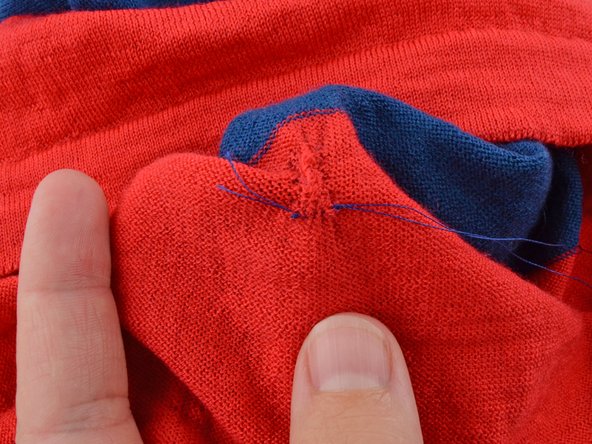
Darn it! You lot've got a hole. Not to worry—fixing a hole in a knitted garment is easy. It merely requires a needle, some thread, and a bit of patience.

Follow this step-past-stride guide for basic instructions on darning. This process can exist applied to any knitted garment from socks to sweaters.

  1. Inspect the damage. Clean any dirt or debris from the area. Tie off any loose threads from the hole.

    • Inspect the damage. Make clean whatever dirt or debris from the area.

    • Tie off whatever loose threads from the hole.

  2. Cut a length of thread. We're using contrasting thread in our guide so that you can see it. However, when it comes time for your repair, you'll want to use thread that matches the color of your garment's fabric so that your stitching is less visible.

    • Cut a length of thread.

    • We're using contrasting thread in our guide then that you lot can see it. Nonetheless, when it comes time for your repair, y'all'll want to use thread that matches the color of your garment's fabric then that your stitching is less visible.

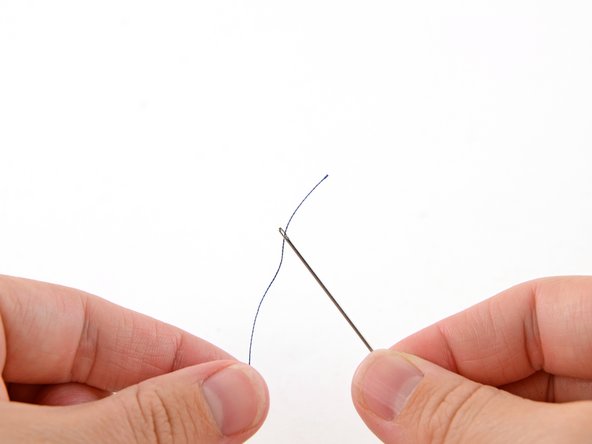
  3. Insert one end of the thread through the eye of the needle. Insert one end of the thread through the eye of the needle. Insert one end of the thread through the eye of the needle.

    • Insert one end of the thread through the eye of the needle.

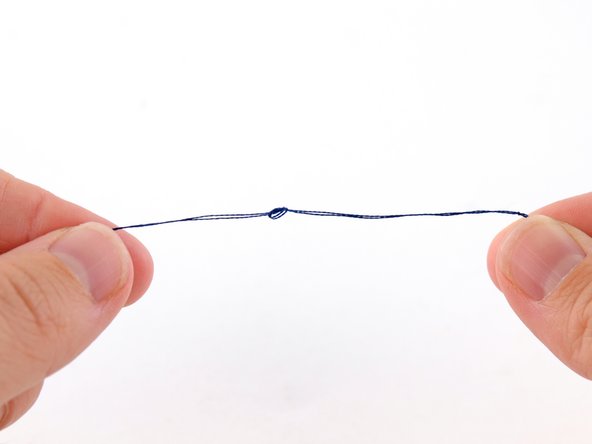
  4. Align the two ends of the thread. Your needle should be threaded between these two ends. Tie the ends off in an overhand knot.

    • Align the two ends of the thread.

    • Your needle should be threaded between these ii ends.

    • Tie the ends off in an overhand knot.

    • Tie a second overhand knot to brand the knot in the thread larger.

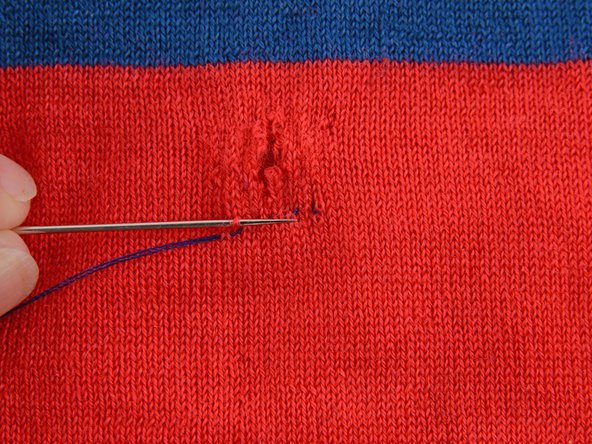
  5. Starting about a centimeter to the side of the hole, and half a centimeter below, insert the needle from the back of the garment. You should only push the needle through one layer of the garment as you work. If you go through both layers, you will sew the garment shut. You should only push the needle through one layer of the garment as you work. If you go through both layers, you will sew the garment shut.

    • Starting about a centimeter to the side of the hole, and half a centimeter beneath, insert the needle from the back of the garment.

    • You lot should just push the needle through i layer of the garment equally y'all work. If you become through both layers, you will sew together the garment shut.

  6. Pull the needle through to the front of the garment until the thread is taut and the knot catches in the back. Take a single straight stitch going into a single layer of fabric and coming back up one row of the knit closer to the hole. Take a single straight stitch going into a single layer of fabric and coming back up one row of the knit closer to the hole.

    • Pull the needle through to the front of the garment until the thread is taut and the knot catches in the dorsum.

    • Take a unmarried straight stitch going into a single layer of textile and coming dorsum upwards ane row of the knit closer to the hole.

  7. Pull the needle through until the thread is taut, but not scrunching or gathering the fabric. Pull the needle through until the thread is taut, but not scrunching or gathering the fabric.

    • Pull the needle through until the thread is taut, simply not scrunching or gathering the fabric.

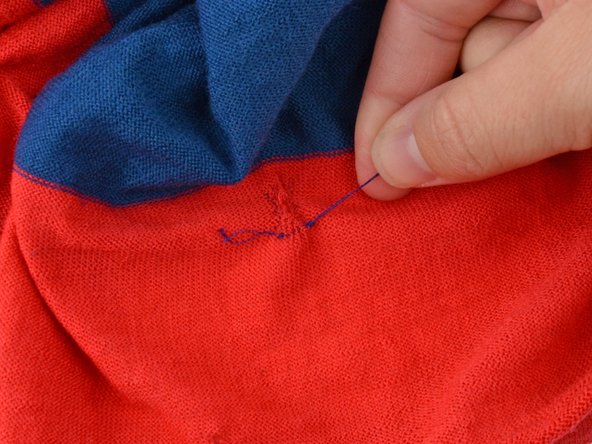
  8. Take another straight stitch towards the hole, going in and out of a single layer of the garment, passing the thread under a single row of the knit. Try to work perpendicular to the grain of the knit, creating a straight row of stitches. Pull the needle through until the thread is taut, but not pulling or scrunching the fabric.

    • Take another straight stitch towards the pigsty, going in and out of a single layer of the garment, passing the thread under a single row of the knit.

    • Try to work perpendicular to the grain of the knit, creating a straight row of stitches.

    • Pull the needle through until the thread is taut, but not pulling or scrunching the fabric.

  9. Continue working across the hole taking stitches under every other row of the knit.

    • Continue working beyond the hole taking stitches nether every other row of the knit.

    • This photo illustrates how the needle should go under every other row of stitches. If y'all are new to sewing, it is improve to take ane sew at a fourth dimension.

    • When you become nigh a centimeter past the hole, pull the needle through until the thread is taut, only not gathering or scrunching the fabric.

  10. Turn the needle around and take a stitch going the opposite direction (towards where you started) just above your last row of stitches. Turn the needle around and take a stitch going the opposite direction (towards where you started) just above your last row of stitches.

    • Plow the needle around and have a run up going the opposite direction (towards where you started) but to a higher place your last row of stitches.

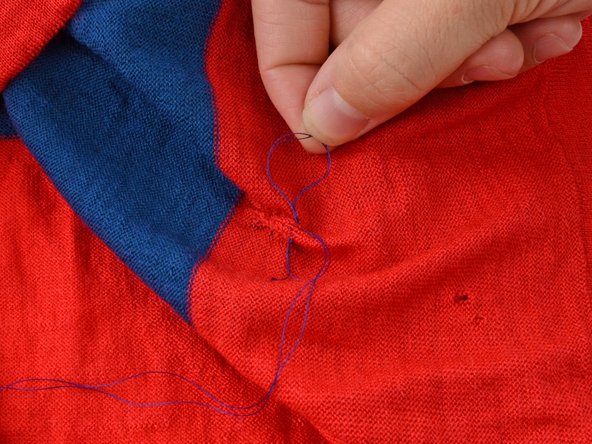
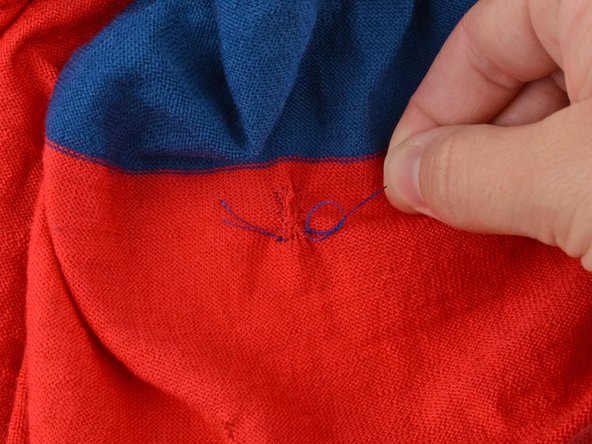
  11. Pull the thread through until it is taut. You should see the thread loop around to go the other direction.

    • Pull the thread through until it is taut.

    • You should see the thread loop around to go the other direction.

  12. Stitch this second row the same way you did the first, but in the opposite direction. This time, go under the rows of knit you previously went over, and vice versa. When you reach the end of this second row, turn around and continue stitching in the previous direction. Stitch rows back and forth until you have worked about a centimeter past the hole.

    • Stitch this second row the aforementioned way you did the first, merely in the opposite direction. This time, go under the rows of knit you previously went over, and vice versa.

    • When you lot attain the finish of this second row, turn around and continue stitching in the previous direction. Sew together rows dorsum and forth until you lot take worked well-nigh a centimeter past the hole.

    • Don't forget to pull the thread taut after each stitch. If you lot are new to sewing, take your time, slowly completing each sew.

  13. When you have finished sewing rows, take the needle and insert it across the top corner of your stitching at a forty-five degree angle, taking a stitch. As you begin to pull the needle through you will see a loop form. Catch the loop with your finger.

    • When you have finished sewing rows, take the needle and insert it across the tiptop corner of your stitching at a xl-five degree angle, taking a stitch.

    • As yous brainstorm to pull the needle through you volition see a loop form. Catch the loop with your finger.

    • Do not pull the thread taut yet.

  14. Insert the needle into the loop. Pull the needle through the loop.

    • Insert the needle into the loop.

    • Pull the needle through the loop.

  15. Pull the thread taut, closing the loop and creating a knot. Pull the thread taut, closing the loop and creating a knot. Pull the thread taut, closing the loop and creating a knot.

    • Pull the thread taut, endmost the loop and creating a knot.

  16. Insert the needle at a forty-five degree angle to your previous stitching, taking the needle under one row of the knit. You will begin to stitch over your previous stitches at a forty-five degree angle, just as before. Remember to only stitch through one layer of the garment.

    • Insert the needle at a forty-five degree bending to your previous stitching, taking the needle under one row of the knit.

    • Y'all volition begin to sew over your previous stitches at a twoscore-five degree angle, simply every bit before. Recollect to only stitch through one layer of the garment.

  17. Pull the needle through until the thread is taut. Pull the needle through until the thread is taut. Pull the needle through until the thread is taut.

    • Pull the needle through until the thread is taut.

  18. Take another stitch crossing your previous stitching at forty-five degrees. Pull the needle through until the thread is taut.

    • Take another sew crossing your previous stitching at 40-five degrees.

    • Pull the needle through until the thread is taut.

    • Continue stitching in this mode until you lot come to the edge of your previous rows of stitching.

  19. When you come to the edge of your stitches, turn the needle around and begin stitching another line of stitches at a forty-five degree angle alongside the line you just made. When you come to the edge of your stitches, turn the needle around and begin stitching another line of stitches at a forty-five degree angle alongside the line you just made.

    • When you come to the edge of your stitches, turn the needle around and begin stitching some other line of stitches at a forty-v degree bending alongside the line yous just fabricated.

  20. Continue stitching, alternating under and over the rows of knit. Don't forget to pull the thread taut after each stitch. Don't forget to pull the thread taut after each stitch.

    • Continue stitching, alternating under and over the rows of knit.

    • Don't forget to pull the thread taut after each stitch.

  21. When you have covered all your rows of stitching with lines of stitching at forty-five degrees, check your work to make sure that the fabric is not pulling or gathered anywhere.

    • When you have covered all your rows of stitching with lines of stitching at forty-five degrees, check your piece of work to make sure that the fabric is not pulling or gathered anywhere.

    • If you lot take a pull or gather, yous can flatten information technology with your finger, allowing the thread to loosen.

  22. Drive the needle into the bottom corner of your stitching. Pull the needle through to the backside (inside) of the garment. Pull the needle through to the backside (inside) of the garment.

    • Drive the needle into the lesser corner of your stitching.

    • Pull the needle through to the behind (inside) of the garment.

  23. On the backside, take a small stitch very close to where the needle came through. Slowly pull the needle through the fabric, creating a loop. Catch the loop in your fingers.

    • On the behind, take a pocket-sized stitch very shut to where the needle came through.

    • Slowly pull the needle through the textile, creating a loop.

    • Catch the loop in your fingers.

    • Put the needle through the loop.

  24. Pull the needle through the loop, creating a knot. Pull the thread taut, tightening the knot. Pull the thread taut, tightening the knot.

    • Pull the needle through the loop, creating a knot.

    • Pull the thread taut, tightening the knot.

  25. Drive the needle under the knot you just created, catching a small bit of the garment in the stitch. Slowly pull the needle through, creating another loop.

    • Drive the needle under the knot yous merely created, catching a small bit of the garment in the sew together.

    • Slowly pull the needle through, creating another loop.

    • Put the needle through the loop.

  26. Pull the needle through the loop creating a knot. Pull the thread taut, creating a knot on top of the knot you previously made. Pull the thread taut, creating a knot on top of the knot you previously made.

    • Pull the needle through the loop creating a knot.

    • Pull the thread taut, creating a knot on pinnacle of the knot you previously made.

  27. Clip the dangling threads and admire your handiwork. This image illustrates how the darning will look when you use matching thread. This image illustrates how the darning will look when you use matching thread.

    • Prune the dangling threads and adore your handiwork.

    • This paradigm illustrates how the darning volition look when you lot use matching thread.

Embed this guide

Choose a size and copy the code below to embed this guide equally a small widget on your site / forum.

Preview

Source: https://www.ifixit.com/Guide/How+to+Darn+a+Hole+in+a+Knitted+Garment/27415

0 Response to "How To Repair A Hole In Knit Fabric"

Post a Comment

Iklan Atas Artikel

Iklan Tengah Artikel 1

Iklan Tengah Artikel 2

Iklan Bawah Artikel