

How To Repair Inoperable Battery-powered Wall Clock
Eugene is a qualified command/instrumentation engineer Bsc (Eng) and has worked equally a developer of electronics & software for SCADA systems.
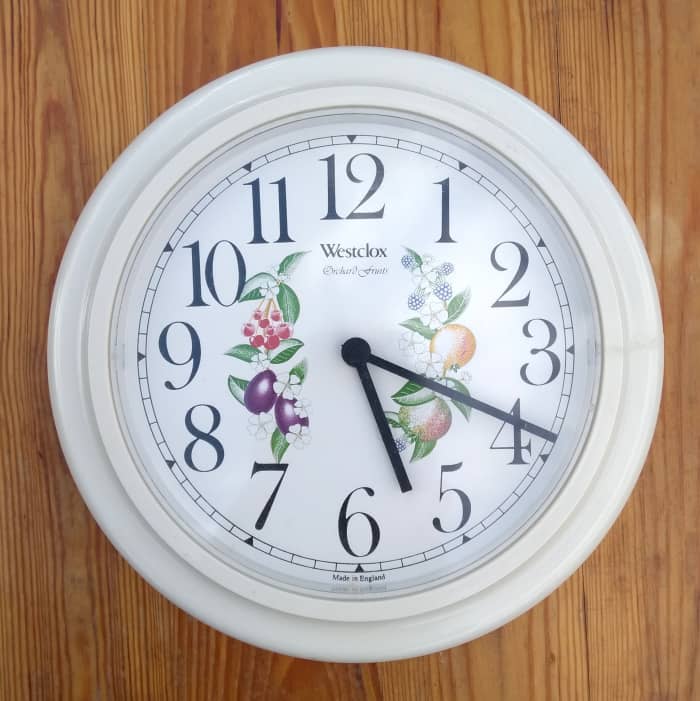
Typical battery quartz electronic wall clock.
© Eugene Brennan
Cleaning Bombardment Clocks
Once upon a time most of our clocks were wind-up devices, then we transitioned to electric clocks that plugged into a mains outlet. Present, many clocks are battery-powered by a unmarried AA cell. The enemy of all clocks though is grit and grime that can easily seize upwardly the cogs and stop the mechanism from working. In this guide, I show yous which parts y'all tin try cleaning to go your clock working again.
Analog and Digital Clocks
The clock I'one thousand fixing here has an analog display. However the electronics that drives the brandish is digital and uses an oscillator and counter scrap for frequency partitioning. To understand the somewhat confusing difference between analog and digital which are words that tin mean different things depending on context, see my article "Analog vs Digital Signals and Displays — What's the Difference".
How Does a Quartz Clock Work?
The mechanism (also called the movement) or working parts in a quartz battery clock is a fleck simpler than in a traditional wind-upwardly clock.
At the heart of the clock is a quartz oscillator, which generates a pulse every second. An oscillator is a device that does something regularly, like a pendulum that swings back and along, a tuning fork vibrating, a cord on a guitar or the air in an organ piping. All these are mechanical oscillators, but there are also electronic oscillators.
An electronic oscillator generates a voltage point that repeats itself at a set frequency. In the case of the oscillator in a clock, this runs at several 1000 hertz or cycles per second. An electronic component chosen a quartz crystal sets the frequency of the oscillator to about 32768 Hz with a high degree of accuracy. The frequency is divided downward and reduced so that it eventually becomes 1Hz or 1 cycle per 2nd. The output of the oscillator drives an electromagnet that acts on a tiny magnetic rotor, flipping information technology half a turn every second. The rotor has gear teeth that mesh with a train of other gear wheels and this eventually turns the hands of the clock.
The good thing about electronic quartz oscillators is that their frequency is very stable and unlike mechanical clockwork, doesn't change much with temperature, humidity or other ambient conditions. This means that battery clocks keep good time and don't gain or lose minutes similar a wind-up clock as the spring unwinds or temperature changes.
Why Do Clocks Stop?
- Loose or dirty battery connections
- Low battery
- Battery pips non long enough
- Grime accumulating in the mechanism causing excessive friction
First Steps: What to Attempt if a Clock Doesn't Work
- Alter the battery. It may simply be flat. You can check battery condition with a universal battery tester like this ane suitable for one.5 volt AA, AAA, C and D cells and likewise small, square 9 volt "PP3" (MN1604) style batteries
- Clean the connections and battery terminals with rubbing alcohol (which is either isopropyl alcohol (IPA) or ethanol) on a cotton bud. The springy electric strips tin can also become oxidised as tin can the ends of the batteries. This oxidisation sometimes appears equally a gray or green blanket. You can use fine wire wool to remove it. If the battery has leaked and left a white deposit (potassium hydroxide from alkaline batteries), you lot tin can neutralise this outset by rubbing with vinegar.
- Check the battery terminals: Sometimes the terminal pips on batteries can exist a little short. Endeavor slightly bending the positive last strip in the clock slightly. Caution! These can snap if you bend besides much.
- Bank check the hands: Make the sure the clock easily aren't rubbing against the clear comprehend over the confront of the clock.
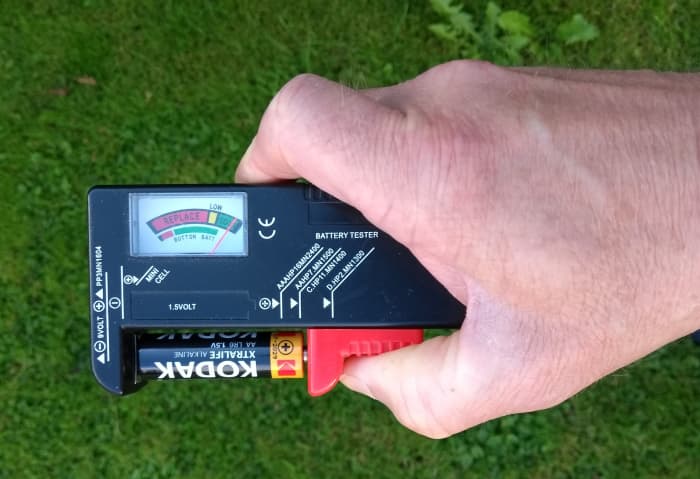
Universal battery checker suitable for AA, AAA, C, D and MN1604 (PP3) batteries.
© Eugene Brennan

Battery connections can be cleaned with isopropyl alcohol (IPA), likewise chosen rubbing alcohol.
© Eugene Brennan
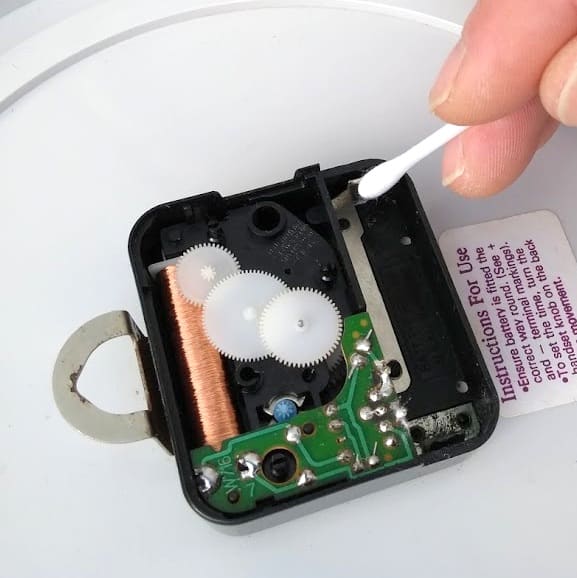
Clean contacts with IPA.
© Eugene Brennan
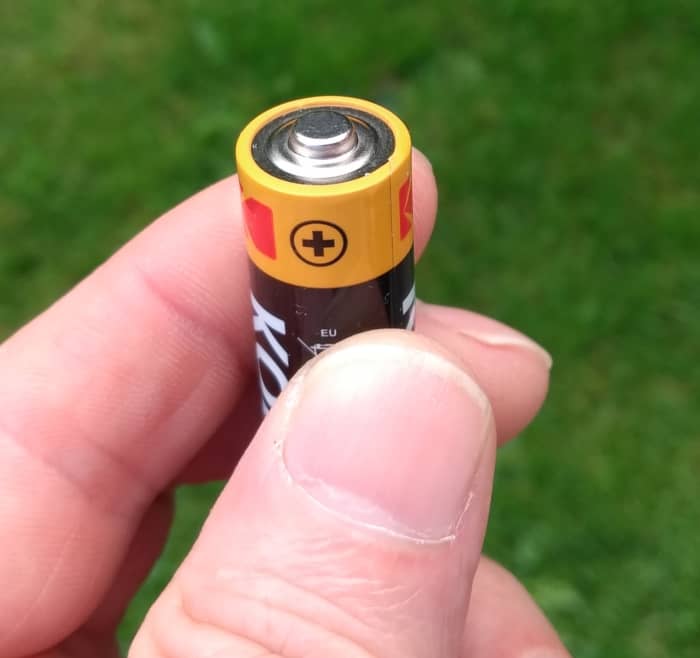
Sometimes batteries tin have short positive terminal pips.
© Eugene Brennan
Endeavor slightly bending the springy terminals if they don't brand contact. Don't overbend.
© Eugene Brennan
Next Steps: If the Clock Yet Won't Run
If the clock still won't run, the cogs inside may accept crud on the teeth or axles. Even though there's a cover on the machinery compartment, in humid, dingy conditions (e.g., in a bathroom) dust and mildew can manage to arrive. So you need to practise some cleaning. The solenoid in the clock but produces a tiny amount of torque or twisting force to turn the little rotor. Whatsoever grime on the pins of this rotor can produce enough friction to stop it from turning.
Scroll to Keep
Read More From Dengarden
How to Clean the Clock Mechanism
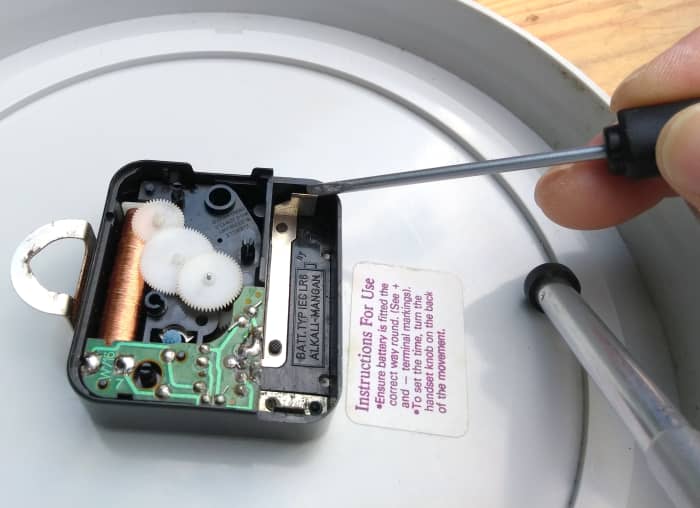
- Remove the cover over the mechanism. This differs from clock to clock. There may be lugs on the mechanism compartment that engage with the comprehend. If this is the case, push them gently aside with the bract of a screwdriver. Alternatively there may be pins that push into the cover like in the photo below. I was able to push button into the hairline gap between the compartment and comprehend with a minor screwdriver and prise upwards the cover.
- Remove the rotor from between the jaws of the solenoid and the starting time couple of gears. These should just lift out without whatsoever difficulty. Friction affecting these gears is nearly probable to stop a clock because further downwardly the gear train, there'll exist more than torque to overcome it. Have a photograph before disassembling and then y'all can put everything back together.
- I have found that furniture smoothen helps to clean and lubricate the tips of the shafts of the nylon gears where they sit into the case and cover. Spray some polish on a tissue or cotton fiber bud and dab information technology onto shaft ends and teeth and wipe off the excess.
- Remove any obvious dust or fluff in the move.
- If you remove some of the gears, the hands of the clock may autumn off, so yous may demand to remove the clear faceplate to supercede them.
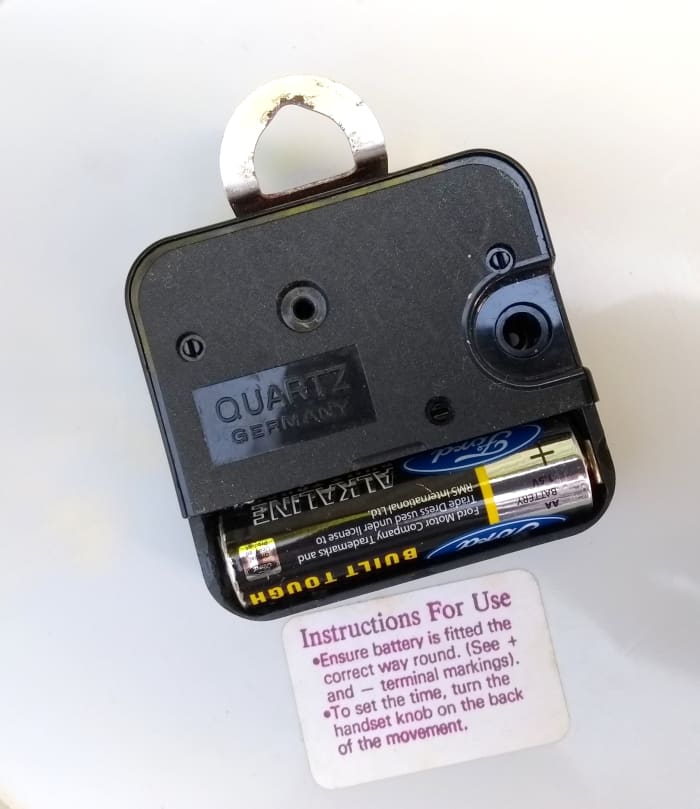
To get at the mechanism, you need to remove the cover on the compartment that holds the gears and electronics.
© Eugene Brennan
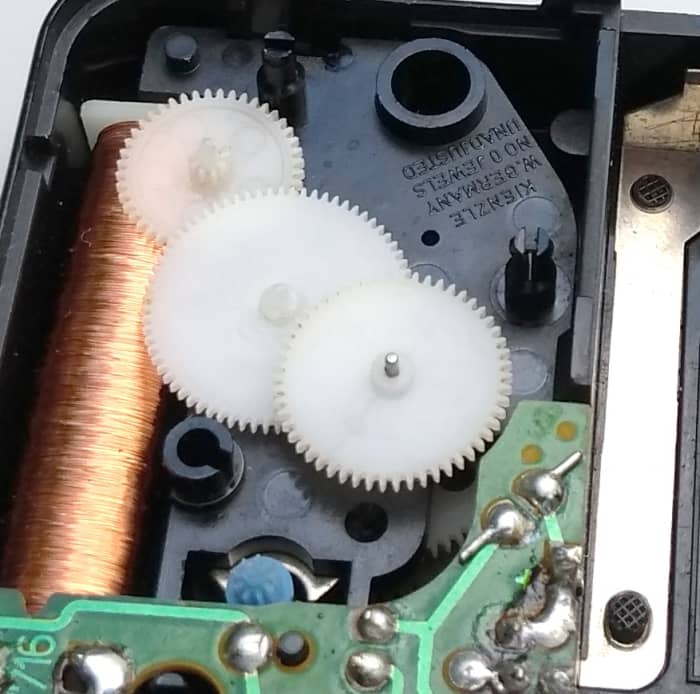
Inside the clock, an electromagnet moves the piddling blue magnetic rotor half a plough every second. This turns the other gears.
© Eugene Brennan
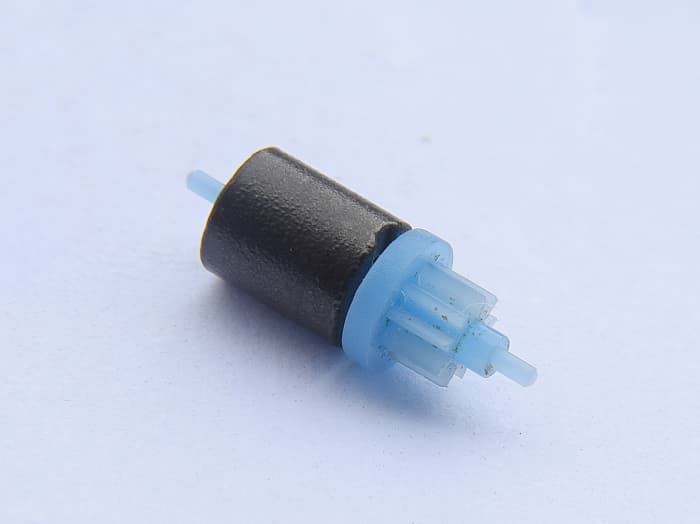
This tiny rotor magnet is most 3/8" or 10mm long. Clean the two ends of shaft pins to reduce friction.
© Eugene Brennan
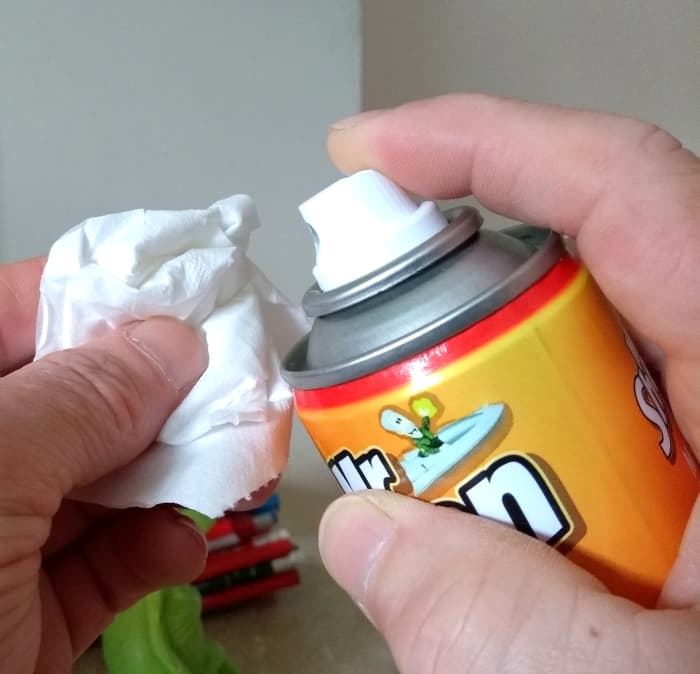
You can make clean and lubricate the tiny shafts of the gears with furniture smoothen.
© Eugene Brennan
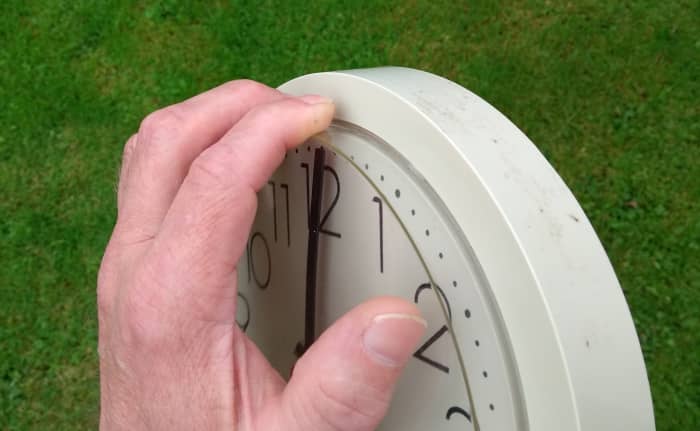
You can disassemble the lugs of the front encompass of some clocks by pushing down with your fingers and pulling out at the same time.
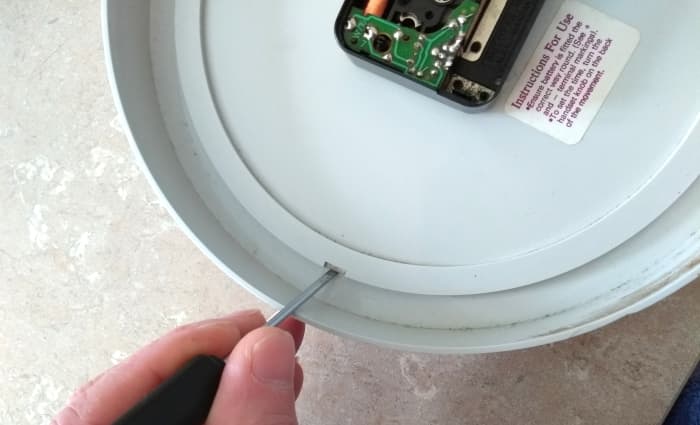
.....alternatively push sideways on the lugs and so push down to remove the faceplate of the clock if you need to supervene upon the mechanism or hands.
© Eugene Brennan
More Possible Fixes
- Check the voltage on the electromagnet: This should modify polarity every second.
- Reflow the solder: If yous have a soldering fe, y'all tin reflow the solder on the joints on the PCB. Sometimes a dry out solder joint tin can preclude the excursion from working or brand it stop working intermittently.
- Cheque the metal strips: On some clocks, the excursion board presses confronting strips of metal that supply power from the battery. These strips are springy and press on tinned pads on the PCB. In a bathroom, steam tin cause corrosion at these points of contact. Remove the PCB and make clean the pads and leap contacts with IPA and fine wire wool.
- Cheque the magnetic rotor beam: The axle of the magnetic rotor can tarnish if information technology'south made of brass, making it rough and increasing friction, causing it to stick. More expensive clocks and watches have jewelled bearings (e.g., rubies) in which the tiny axles of the cogs rotate, nevertheless cheap quartz clock movements just have a nylon plate into which all the axles of the cogs fit. Yous tin can endeavor adding a tiny drop of oil, (less than the size of the head of a pin) using the tip of a pivot or a pointed awl to the signal where the rotor axle fits into this plate.
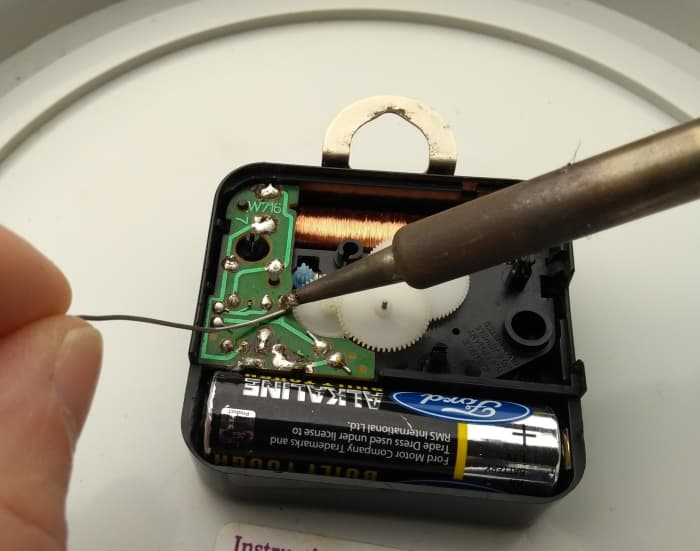
Reflow solder on the joints.
© Eugene Brennan
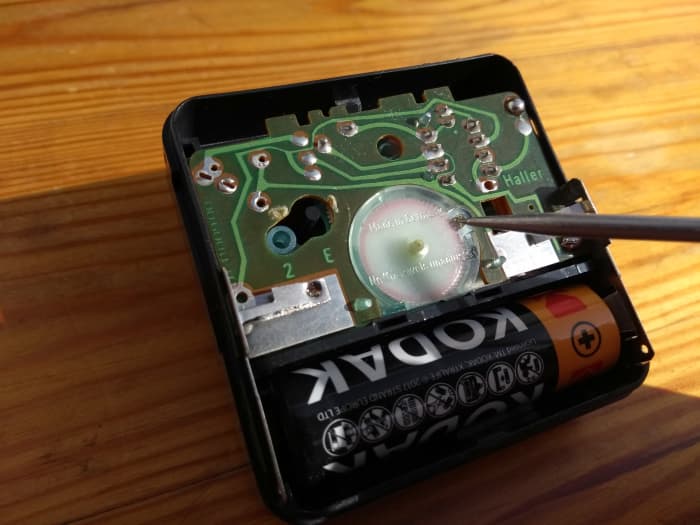
Employ the tip of an awl or pivot to employ a tiny drop of oil to the bearing.
© Eugene Brennan
If the Clock Still Won't Start, Supplant the Mechanism
It turned out that the electronics of my clock in the photos above was faulty. You can buy a replacement motility like this one on Amazon. This product has basic apparently hands.
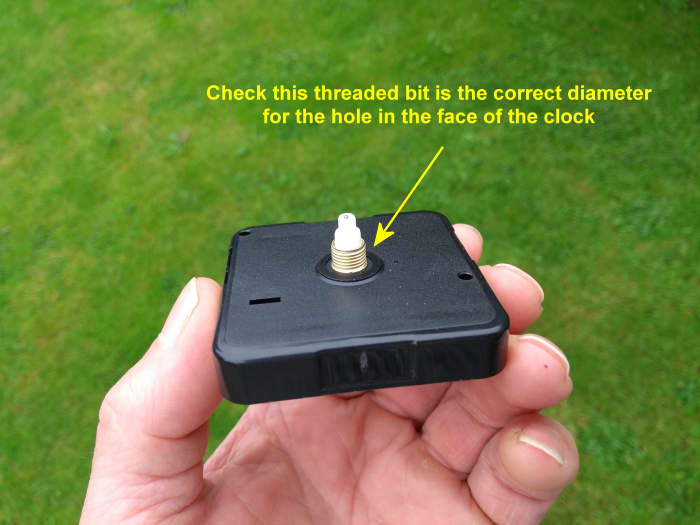
Mechanisms are somewhat non-standard, so you'll need to check that the hands are the right size and volition adapt the style of your clock. Alternatively, if they are plain rectangular types, you demand to check that they can be cutting and shortened. The threaded piece that fits into the hole in the face of the clock sometimes differ in diameter and length. This should be long enough that any condom washers to terminate the mechanism turning and bracket hooks for fixing to a wall can exist replaced with the piece projecting sufficiently to fix it in place with the retaining band. Bore isn't as critical, merely it should exist small enough and then it fits through the hole. If information technology's too small, it's a piffling more tricky to keep the mechanism centered properly.
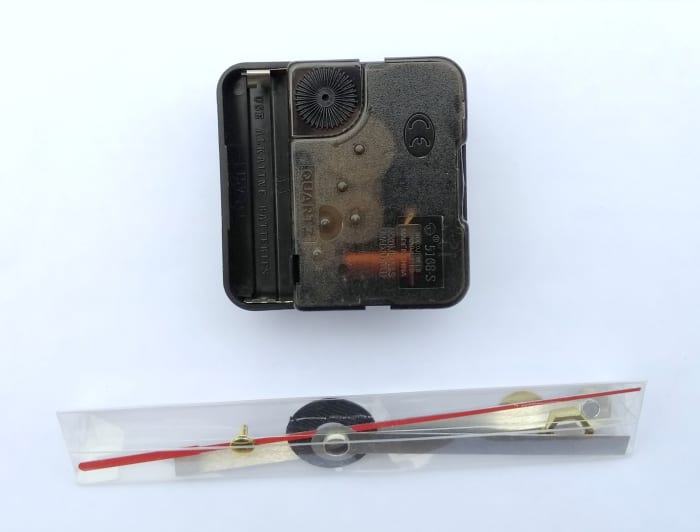
You lot can buy replacement mechanisms for a few dollars.
© Eugene Brennan
© Eugene Brennan
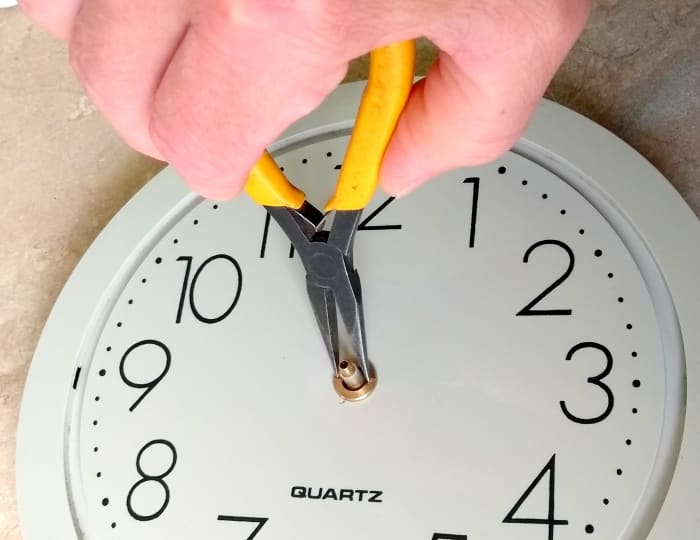
Adhere the retaining band for the clock movement. Don't excessively tighten information technology as it can deform the insides of the movement.
© Eugene Brennan
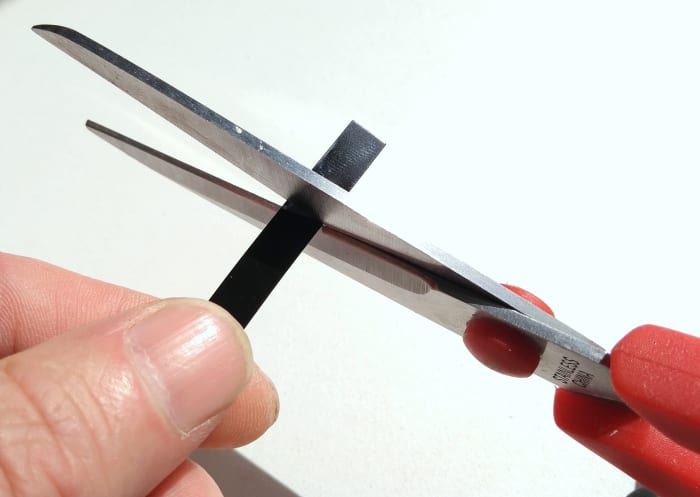
You may need to shorten hands. Y'all can probably use a sharp scissors.
© Eugene Brennan
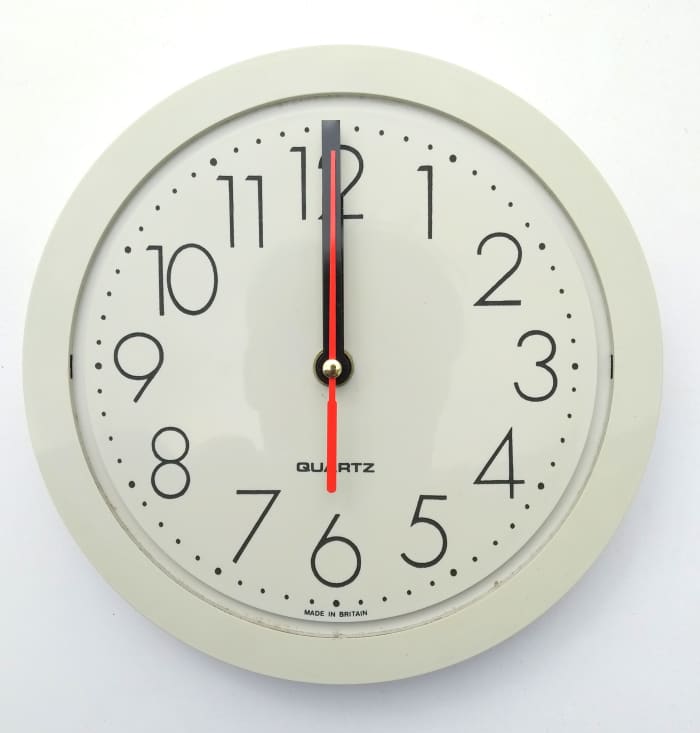
Supplant both the hour, minute and second hand (if supplied) and bespeak them all to 12 o'clock. So set up the fourth dimension afterward replacing the bombardment.
© Eugene Brennan
Using Flat AA Batteries
When a gadget indicates that the batteries are flat, this is often because electronics or software detects that the voltage is below a threshold level sufficient to run the device. This happens with high-power devices that need a minimum voltage to operate. Nevertheless the energy remaining is often acceptable to run battery clocks for up to vi months.
References
Wikipedia: Quartz Clock
This content is accurate and true to the best of the writer's knowledge and is not meant to substitute for formal and individualized advice from a qualified professional.
© 2022 Eugene Brennan

How To Repair Inoperable Battery-powered Wall Clock,
Source: https://dengarden.com/misc/How-to-Fix-a-Quartz-Digital-Clock-That-Wont-Work
Posted by: jimenesowely1988.blogspot.com
0 Response to "How To Repair Inoperable Battery-powered Wall Clock"
Post a Comment