

How To Install Bird Spikes On Roof
- Scottish Market Shoppers Attacked by Dive-Bombing Gulls
-

Dumfries, a market town in Scotland, is being besieged by seagulls. At least two-dozen people have been attacked or had their lunches taken or "sampled." Shoppers on High Street have been warned to watch out for the dive-bombing gulls. The large birds circle outside, just waiting for customers to walk out of shops. The birds have gotten so bold that they routinely swoop into shops to steal rolls from display baskets. Customers have been forced to literally conceal their food and not eat it in open view. At least four seagull attacks occur daily with the brazen birds "relieving" customers of their steak bakes or sausage rolls.
Gulls hovering around seaside eateries have always been a problem, regardless of their geographic latitude. Before they can harass customers in any commercial venue, gulls need a place to perch and observe. Effective bird controls can deny them that perch and force them to move on. One of the best anti-perching, anti-roosting bird deterrents currently available is the Stainless Steel Bird Spike.
Bird Control Starts with a No-Landing Zone
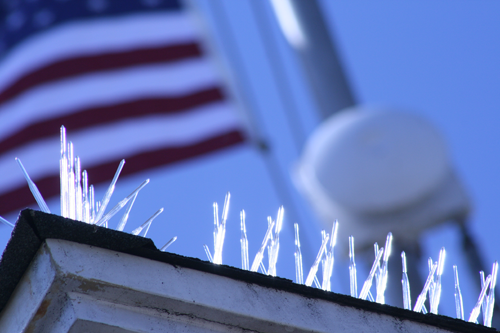
Stainless Steel Bird Spikes will not permit large birds—like seagulls—to land on or near them. The spiked strips prevent birds from gathering on ledges, rooflines, parapet walls, eaves, I-beams, windowsills, signs, light posts, awnings and canopies. Blunted at the tips, the spikes won't harm birds, pets or people, and they have been approved by a number of humane groups—including the U.S. Humane Society.
A Bird Deterrent that Prevents Many Problems
When large birds perch and roost, they not only discourage customers, but can creates all sorts of maintenance, cleanup and repair problems for property owners. Bird droppings can quickly deface and permanently mar signs, canopies, umbrellas, windows and doors. Birds also pose a health hazard, a real problem for any establishment that sells or serves food. Bird droppings can carry any of 60 known diseases, including salmonella. Bird nesting debris can block vents, and prevent AC units from functioning properly. It can also create the kindling that can cause electrical fires. Stainless Steel Bird Spikes can prevent these and other bird-related problems.
Easy to Choose, Easy To Install
The Stainless Steel Spiked Strips come in two-foot sections, providing up to 40 spikes per foot in a linear array. You can also choose the spike width that fits your bird problem area—3-, 5- and 8-inch sizes are available. Each spiked strip is just 1.5 inches wide, so installing it on narrow surfaces is easy. A built-in glue tough and pre-drilled mounting holes further simplify installation. The spike's flexible base bends a full 360 degrees, allowing the spiked strip to follow the curved surfaces of lampposts, signs and other architectural features. The virtually invisible spikes feature a patented "bend and crush" design to ensure they stay secured in the base.
Stainless Steel bird spikes are embedded in unbreakable UV-protected polycarbonate base to last for years. Each is manufactured in the USA and comes with a 10-year guarantee.
- Top 2 Bird Control Devices for the Water Utilities Industry
-
-
-
 birdbgone
 - January 9th, 2014

Water utility facilities require considerable upkeep and maintenance. With municipal budgets stretched during these tough economic times, reducing the cost of maintenance is crucial. One way to do that is to cost-effectively control the pest bird problem around your facility.
Birds have a habit of nesting in the nooks and crannies of the various structures, towers, storage areas and pipes in and around a water facility. When they do, you'll find accumulated bird droppings virtually everywhere. Left to harden, bird droppings can seize up valves, cover up gauges, and lock up bolts and covers—all of which can make routine maintenance a costly, time-consuming job.
Bird droppings can also create dangerous slip-and-fall hazards for maintenance crews tasked with climbing ladders and crossing pipes, water towers and elevated landings. Injured workers mean lost time and slipped maintenance schedules. The solution is to implement effective bird control measures to keep birds away from your facility. Here are two bird deterrents that water facilities mangers have found particularly effective:
1. Stainless Steel Bird Spikes
Proven in industrial facilities worldwide, Stainless Steel Bird Spikes provide an anti-perching, anti-roosting barrier against a variety of large pest birds—like crows, gulls and pigeons. These specially designed spiked strips keep birds off towers, valves, landings, support structures and other elevated areas. They are easily installed in multiple rows to deter birds from large, wide areas; they can be affixed to conduit, ledges, and pipes via ordinary hose clamps, Nylon ties or wire lashings; they can be mounted in any lofty area using intertwining vertical and horizontal spiked rows; and they can be placed atop posts, gangways and curved surfaces using adhesive with Nylon ties or hose clamps. The best stainless steel bird spikes are made in the USA and have their spiked pins tightly embedded in a UV-protected polycarbonate base. These high quality stainless steel spikes come in 1", 3", 5" and 8" widths to provide wider and wider areas of deterrence. The spiked strips come with pre-drilled holes and glue troughs to make installation fast and easy.
2. Bird Chase Super Sonic
Designed for deterring pest birds from large outdoor facilities, the Bird Chase Super Sonic System covers a full acre, broadcasting intimidating sounds birds can't stand. Additional portable speakers can be easily attached to extend the effective range to five acres. Unlike ultrasonic systems that emit sounds birds can't hear, the Bird Chase system broadcasts predator and distress calls within the hearing range of birds. The sounds resemble normal birdcalls so they won't annoy your daily crews. You can program the system to turn off at night and on at daybreak when birds become most active. Another plus is that Bird Chase Super Sonic emits distress and predator calls for 22 types of birds to protect your facility from virtually any type of bird.
-
- How Bird Spikes Can Protect Your Home from Pest Birds
-
-
- birdbgone
- December 20th, 2012
by Alex A. Kecskes
If you're like most homeowners, you spent some time this summer painting your home. You may also have painted your patio covers, gazebos, and fencing. To protect your roof, probably cleared out your rain gutters, getting rid of some bird nests and bird debris. And you may even have cleaned off walkways, pool and spa areas that were covered with bird droppings. As an informed homeowner, you know that bird droppings can carry any of 60 known diseases. So the last thing you want is bird droppings on or near your pool, spa, patio tables and chairs, or BBQ.
The good news is your home and its surroundings are now sparkling clean and fresh; the bad news, the pest birds that created all those droppings will probably be back--unless you take steps to bird proof your home.One of the pest ways to bird proof is to install some Bird Spikes along the rooflines of your home, on the tops of your patio covers and gazebos, and any other elevated areas of your property. Properly installed, these bird deterrents can keep a wide variety of pest birds--especially large birds like pigeons and crows--from perching and pooping all over your home and property.
The bird spikes that last the longest are constructed of flexible, marine-grade stainless steel and feature a U.V.-protected polycarbonate base. Some bird spikes come with a non-reflective metal finish, which means they won't stand out on your roofline or patio cover. Steel bird spikes come in 3-, 5- and 8-inch widths to cover areas up to 8 inches wide. For large birds like crows and gulls, you'll need an 8-inch wide spike.You can also get plastic bird spikes. These are less expensive than stainless steel spikes and will last many years. They come in a variety of colors to match your home's color scheme. Available colors include white, tan, gray, black, brown, brick red and crystal clear. These spikes come in 3-, 5- and 7-inch widths to protect areas up to 7 inches wide. For mid-sized pest birds--usually from 9.5 to 11 inches long--you'll need a 3-inch wide spike. One advantage of plastic spikes is that they can be installed near your dish TV antenna without worries about RF interference.
To keep your rain gutters clear of pest birds and nests, you can install some Gutter Bird Spikes. The best gutter spikes feature adjustable clamps at the base, so you can easily mount them to the lip of your gutter. If your home is out in the country or near the sea or a lake, you may be tired of dealing with really large pest birds like cormorants, turkey vultures or raptors. This is where you'll want to invest in the Mega Spike, which features long, 7-inch spikes.
Regardless of which you choose, bird spikes typically come in two-foot sections. Better bird spikes will feature pre-drilled holes and glue troughs for fast, easy installation. The best bird spikes are blunted at the tips and won't harm birds or pets. They have been approved by a number of humane groups worldwide, including the U.S. Humane Society and PICAS (Pigeon Control Advisory Service).
Before installing plastic bird spikes, make sure the surface is clean and dry. Be sure to remove any loose rust, peeling paint, bird droppings, feathers and nesting materials. Use commercial disinfecting cleaning agents to prevent exposure to any of the 60 known airborne diseases carried by birds. If the area is heavily contaminated with bird droppings, be sure to use proper eye and respiratory protection.
-
- Using Pigeon Spikes to Keep Pigeons from Roosting and Nesting
-
-
- birdbgone
- September 24th, 2012

by Alex A. Kecskes
Ever wonder why you don't see many pigeons in Disneyland? After all, the place is a food paradise for pest birds, what with popcorn and food scraps under tables and chairs in just about every Kingdom. The reason is simple: the Magic Kingdom uses one of the most effective bird deterrents ever devised--the Pigeon Spike. You can see them if you really look for them. They're on many light poles and other lofty fixtures, structures and buildings. But they blend in because the spikes come in various colors.
The ubiquitous rock dove or pigeon is now just about everywhere. They have learned to live with humans and will boldly move into an area, digging for food in and around restaurants, trash bins, schools, colleges, amusement parks—anywhere there are people.
To survive, pigeons need a place to land and observe their surroundings. They'll survey an area before roosting and nesting to makes sure there are plenty of food scraps, water and protection from predators and the elements. Unless there are deterrents like pigeon spikes to discourage them, they will quickly invade an area and take it over.
If you're a property owner, you need to act proactively to ensure pest pigeons don't invade your property and create an unhealthful mess. One way to keep them away is through the proper use of effective pigeon spikes.
Pigeon spikes won't allow these pest birds to land. The specially designed spike strips are easily mounted on rooftops, parapet walls and ledges using glue, nails or screws. Bird spikes come in rigid U.V.-resistant unbreakable polycarbonate spikes or high strength, durable stainless steel. The less expensive poly spikes are suggested for use around RF or cell phone antennas, since they won't interfere with radio transmissions. Pigeon spikes also come in different colors--including white, tan, gray, black, brown, brick red and crystal clear so they'll blend in better with a structure or building. One manufacturer offers bird spikes with a non-reflective metal finish.
Before you install pigeon spikes, clean the area thoroughly of bird droppings, feathers and nesting materials. Pigeons are attracted to this debris and will consider the area "friendly." Use commercial disinfecting cleaning agents to reduce your exposure to any of the 60 known airborne diseases carried by birds. In some cases, it may be necessary to equip cleaning crews with PPE (Proper Protective Equipment) in the form of eye and respiratory protection. In severely infested areas, you may need to hire certified bio-hazardous waste removal companies to do the job. After live enzyme treatments are applied, germicides/viruscides or both may have to be employed to ensure that pathogens are completely removed.
When installing bird spikes, make sure to leave no gaps for the pigeons to squeeze through. Stainless steel spikes come in 3-, 5- and 8-inch wide spiked strips. The 3-inch spikes offer 2 to 4 inches of coverage on a 5-inch wide ledge; the 5-inch spikes will protect 5 to 7-inches on a 7-inch wide ledge; and the 8-inch spikes will cover 8 to 10 inches on a 10-inch wide ledge. One manufacturer offers a stainless steel bird spike with a patented "bend-and-crush" design for permanent installations. The best pigeon spikes feature a unique "no-nest" design with no-gap spacing to deter birds from roosting or landing.
Sometimes pigeons will build nests in rain gutters. This can clog the gutters and prevent them from directing water away form the roof. This, in turn, can cause extensive water damage. In this case, you should install Gutter Spikes, which are specially designed to fit onto gutters.
The best way to deter pest pigeons is through the use of effective bird deterrents like pigeon spikes. Once installed, they require very little maintenance. The best spikes will offer years of service and will hold up under harsh weather conditions.
-
- Get Rid of Pest Birds with Plastic Bird Spikes
-
-
- birdbgone
- September 5th, 2012
by Alex A. Kecskes
Alnwick and Amble, two small market towns in north Northumberland, England, had a real pest bird problem a few years ago. Both towns have historically suffered from pigeon infestations and messy droppings along its streets and market areas.
The pigeon droppings had defaced pavements, walls and rooftops, and had even blocked gullies and drains in the two towns. Pigeons had become a serious problem in Alnwick, particularly in the Market Place, along Fenkle Street and Narrowgate. In Amble, the pigeons had begun to roost on several buildings along Queen Street and on Lawrence's DIY store on Bridge Street.
The townsfolk had a number of meetings, and suggestions for solving the pigeon problem included the creation of a pigeon loft where the birds would be attracted to nest. The plan was to remove the eggs and replace them with dummy eggs. This, it was hoped, would reduce the exploding pigeon population. At one time, the Amble city council had even allowed firearm culling, but those methods were soon abandoned because citizens felt it was cruel to simply shoot the pigeons.
If only the townsfolk of Alnwick and Amble had consulted some professional bird control experts, their pest pigeon problems could have been solved efficiently and humanely, for among the many tools in a pro bird controller's arsenal is the Plastic Bird Spike
Unlike firearms and birth control measures, plastic bird spikes are perfect for deterring pigeons, crows, gulls, vultures and raptors. These versatile bird-proofing devices are widely used on rooftops, ledges, signs and other elevated areas. The blunted spikes are harmless to birds, pets and installation or cleaning crews. The devices have been approved by the U.S. Humane Society and PICAS (Pigeon Control Advisory Service). In addition, plastic spikes are also GSA approved (U.S. General Services Administration).
Plastic bird spikes are made of a polycarbonate material that can be used around electrical and RF transmission equipment. They can be installed around cellphone antenna arrays and other radiating devices. The best plastic spikes are U.V. protected to withstand years in the sun and punishing weather. One popular plastic bird spike can withstand temperature extremes form +310 degrees F to -200 degrees F. It comes with a full 5-year guarantee.
To blend in better with their surroundings, plastic bird spikes now come in a full range of colors--including white, tan, gray, black, brown, brick red and crystal clear. Even custom colors are now available. It's small wonder architects and builders so often recommend plastic bird spikes as a bird control measure. Plastic spikes are also less expensive that steel bird spikes. This makes them ideal for large installations or for those on a very tight bird control budget.
Another advantage of plastic bird spikes is that they are virtually maintenance free and require no assembly. The spikes come in a variety of sizes--typically 3-, 5- and 7-inch widths and two-foot sections. A single row of plastic bird spikes usually covers a 7-inch wide area. For easy installation, look for plastic spikes that have a flexible base that you can bend and turn to fit onto any flat or curved surface. In some cases, the spike strips have been pre-drilled with holes along the base for fast, easy installation. You can also glue the strip by using the glue trough (a feature found in better spikes) on the base of each spike strip. Use outdoor polyurethane construction adhesive to firmly secure the spikes. Remember to close up any gaps between spike strips to less than two inches. For extra wide ledges, use three or more rows of spikes and be sure to limit the gap between rows to less than two inches.
Finally, before installing plastic bird spikes, make sure the surface is clean and dry. Clean out any loose rust, peeling paint, bird droppings, feathers and nesting materials. Use commercial disinfecting cleaning agents to prevent exposure to any of the 60 known airborne diseases carried by birds. If the area is heavily contaminated with bird droppings (wet or dry), use proper eye and respiratory protection.
-
- Protect Your Home from Pigeons with Bird Spikes
-
-
- birdbgone
- August 16th, 2012

by Alex A. Kecskes
Unless you protect your home with effective pest bird deterrents—like Bird Spikes—pigeons can cause a considerable amount of damage. Like most birds, pigeons look for sunny areas that provide safety from predators and shelter from the elements. They also look for venues that offer a close proximity to food and water. Most homes offer these and other advantages to pigeons.
A favorite nesting place for many pigeons is the rain gutter. The dish-shaped runways offer ideal nesting sites for most nests. While it's great for pigeons, it's bad for homeowners. The nests are often filled with bird droppings and form a solid clump that blocks gutters, sending water under roofing tiles and shingles, and eventually causing leaks when it rains. All the more reason to install specially designed bird spikes for gutters called Gutter Spikes. The best gutter spikes have adjustable clamps at the base, which makes them easy to mount to the lip of your gutter.
Another headache caused by pigeons occurs when they nest and roost on and in your home. Pigeons like to gather on rooftops because it affords them a "bird's eye" view of the landscape, allowing them to spot predators, water and food. If you have a broken attic window, vent grille or loose soffit, pigeons will end up in your attic and that can be a real problem. It's surprising how little an opening they need to sneak into an attic. Bird spikes can keep them out—but you have to install the spikes before flocks of pigeons show up.
Once inside, the scent and cooing of pigeons will attract other pigeons (pigeons are very sociable) and before long, you'll have a sea of nests and mini mountains of poop in your attic. This can create a potential fire danger and a breeding area for disease. Pigeons can carry and/or transmit any of 60 diseases—including bacterial, viral, parasitic and fungal. Chief among these are Histoplasmosis and West Nile Virus. There's also the noise factor, which can drive you crazy in the mornings. You can eliminate these headaches by installing bird spikes.
The high levels of uric acid in pigeon droppings can etch most surfaces--including brick, concrete, metals, paints and marble. If you leave your boat, car or RV in the driveway, pigeon droppings can eat into and permanently mar the paint. If you have a rooftop AC unit, solar heating panels or circulating air vents, pigeon droppings can damage these systems over time (unless you regularly clean the pigeon droppings off your solar panels, the efficiency of these panels will be drastically reduced). To save your home, car, boat and RV from the ravages of pest pigeons, you should install bird spikes, the proven effective pigeon deterrent.
The best bird spikes are constructed of flexible, marine-grade stainless steel and feature a U.V.-protected polycarbonate base. Some bird spikes are available in a non-reflective metal finish, which means they'll blend in more easily to your home's aesthetics. Steel bird spikes come in 3-, 5- and 8-inch widths to cover areas up to 8 inches wide. Mid-sized pest birds, like pigeons, can be easily deterred by a 3-inch wide spike.
If you're on a budget, you can get plastic bird spikes. They do the job nicely and last many years. They also come in a rainbow of colors to match your home's color scheme. Current colors include white, tan, gray, black, brown, brick red and crystal clear. These spikes come in 3-, 5- and 7-inch widths to protect areas up to 7 inches wide. Consider plastic spikes if you need to protect areas near your dish TV antenna, as the plastic won't interfere with the antenna's ability to pick up signals.
If your home is near the sea or a lake, opt for a bird spike called the Mega Spike. It's ideal for deterring large pest birds like cormorants, turkey vultures or raptors.
Installing bird deterrents is easy. Especially if you choose high quality bird spikes. These come with pre-drilled holes and glue troughs for fast, easy mounting. The best bird spikes are blunted at the tips and won't harm birds or pets. They've been approved by a number of humane groups worldwide, including the U.S. Humane Society and PICAS (Pigeon Control Advisory Service).
Before you install bird spikes, make sure the surface is clean and dry. Prepare the area by removing any loose rust, peeling paint, bird droppings, feathers and nesting materials. Use commercial disinfecting cleaning agents to prevent exposure to airborne diseases carried by birds. If the area is heavily contaminated with bird droppings, use proper eye and respiratory protection.
-
- How to Keep Gulls Away from Your Home
-
-
- birdbgone
- August 10th, 2012

by Alex A. Kecskes
If your home has been besieged by gulls, you know what a nuisance they can be. These scavengers will eat just about anything that's on your patio, boat dock or backyard. That includes fish, insects, mollusks, worms, mice, young birds, bird eggs, and berries. When gulls feast and gather, they'll leave an awful mess. They can cover your backyard and patio area with smelly, disease carrying droppings and rotting fish. If they use your rooftop to tear apart their prey, they can dislodge and damage roofing tiles and other rooftop structures.
Like most birds, it's not just one type of gull you have to worry about. There are over 45 species of gulls. Your typical gull is a medium to large bird with a mostly white body and grey or black markings on the wings and tail. Their stout, orange bills and webbed feet make them easily recognizable. While gulls are often found near large bodies of water like bays, inlets and lakes (as well as the ocean), they have been known to venture inland for food. So don't be surprised to see them on the roof of your home or patio if your home is miles inland.
To keep gulls away from your home, you should first remove any open food source such as open trashcans or pet food. After that, you'll need some effective bird control measures to keep them away. Here are three bird deterrents the pros use:
Bird Spikes for Gulls
Gulls regularly choose the roof of a home or structure to roost on. The peak of a roof is an especially desired area as it provides a nice look out point for food and predators. Bird Spikes are a humane product used to keep gulls off roof lines, parapet walls, pilings and other areas. Bird Spikes simply create an uneven surface that gulls know they cant land on. Spikes that are pre-assembled, such as the Stainless or Plastic versions are easiest to install.
Bird Spiders
Bird Spiders have spindly arms that whip about in the wind. Gulls see these and will simply move on to a friendlier landing perch. Bird Spiders are easy to set up on decks, posts, atop light fixtures, rooftops, fixed umbrellas and awnings. These bird deterrents are available in 2-, 4-, 6- and 8-foot arm lengths to create larger and larger areas of bird deterrence. Look for bird spiders that feature a glue-on base, which can be attached to most surfaces.
Sonic Gull Control
No gull likes to hear his fellow gulls being attacked. Or the sound of Peregrine falcons screeching in for the kill. Bird Sonic Deterrents exploit these fears and drive gulls away. These devices broadcast prerecorded distress and predator calls that resemble normal bird sounds to humans. One popular device features a built-in speaker that covers up to one acre. The unit can be programmed to turn on or off at night, and you can even adjust the volume.
-
- Using Bird Spikes to Keep Birds off Your Patio and Roof
-
-
- birdbgone
- August 6th, 2012

by Alex A. KecskesAs a homeowner, you want to keep your roof and patio free of pest birds. Their droppings can quickly ruin the appearance of your home. And the acidic nature of bird droppings can eat into the paint covering your patio. These days, many homeowners have opted for vinyl patios, which can be permanently damaged by a build up of bird droppings.
Getting rid of birds is not always easy. You can scare them away with a water hose or loud noise, but they'll be back minutes after you leave. Poisons and pellet guns are no solution, either, for these methods are inhumane and dangerous to pets and children.
The only solution is proper and humane bird control. And one of the most proven effective and humane devices ever developed to deter pest birds is the Bird Spike. These popular bird-proofing devices have been widely used to keep birds away from homes and buildings. Bird spikes work because they won't allow pigeons, seagulls, crows or similar large birds to negotiate a landing, so birds leave.
Bird spikes come in either rigid U.V.-resistant unbreakable polycarbonate or high strength, durable stainless steel. The poly spikes cost a bit less and are available in 3-, 5- and 7-inch widths. One manufacturer offers poly spikes with a 5-year guarantee. They come in 2-foot long sections and are boxed to cover 6, 20 and 50 feet. Today's poly spikes even come in a stylish array of colors--like white, tan, gray, black, brown, brick red and crystal clear--to blend in with your home's color scheme. Installed properly, they are practically invisible.
For best results, bird spikes should be installed on rooflines, under eaves, on top of patio covers, fixed awnings and other elevated areas. The spiked strips are easy to install. They can be glued down, nailed or screwed into virtually any surface. The best bird spikes will already have pre-drilled holes or glue troughs to make installation fast and easy. Try to get bird spikes that are crush proof and have a non-reflective finish.
By the way, pest birds will often build nests in your rain gutters, which can lead to overflowing water that can seep under roofing tiles. Before you know it, you'll have a leaky roof and expensive roofing repairs. To keep birds out of your rain gutters, you should install Gutter Spikes. These specially designed bird spikes feature adjustable clamps at the base so they can be readily affixed to the lip of your rain gutters.
Before installing any bird spikes, thoroughly clean the surface. Be sure to remove any loose rust, peeling paint, bird droppings, feathers and nesting materials. Use commercial disinfecting cleaning agents to prevent exposure to any of the airborne diseases carried by birds. You should also use eye and respiratory protection if the area is heavily contaminated with droppings.
-
- Get Rid of Pest Birds with Stainless Steel Bird Spikes
-
-
- birdbgone
- January 26th, 2012
by Alex A. Kecskes
Lately, you've noticed some really big birds swarming around your property. One look at these bad boys and you know you're in for some serious bird droppings, noise, debris and perhaps even an attack or two on your dog or cat. You whip out your BB gun, take a few down and they scatter. But the next day they're back with a vengeance, as if to pay you back for "taking out" a few of their own. They've also dropped a load or two on your car, boat and BBQ. After spending considerable time, soap, disinfectant and some major elbow grease in removing the acidic droppings, you realize short-term measures simply won't do. Time to get some serious non-lethal bird control—time for Stainless Steel Bird Spikes.
You read about these spiked strips. They get the job done. Birds just can land anywhere near them, so they wing it to another neighborhood and wreak havoc on their property. You also heard about plastic bird spikes. They're less expensive, but some of these will crack and turn to straw after a few hot summers. There's also iron bird spikes, but you know that a good rainy season will turn them into rust. And when they rust, they leave those ugly brown trails down your property, tracks that make your building look like a haunted mansion.
Besides, you're an all or nothing kind of person. You want the best, the longest lasting, the most durable spikes with the most humungous guarantee. Stainless steel spikes are your choice. They're ideal for achieving bird control in Light to Heavy Bird Pressure environments—in enclosed or exposed areas.
So what's Bird Pressure? It's a metric that establishes how determined pest birds are in staying on your property. Heavy pressure areas will have lots of birds nesting or roosting at the site with a food or water source nearby. Medium Pressure is often a food or afternoon resting site, but not used for nesting or roosting. Light Pressure sites offer no food or shelter and birds stop only briefly during the day. You've concluded that you have a really heavy pressure situation, so you opt for stainless steel.
Where to install them? The experts say to mount them on ledges, I-beams, parapet walls, conduits and signs--on any flat or curved surface where pest birds tend to gather. You also like the choices you get with stainless steel bird spikes. These come in rows of spiked strips in 3-, 5- and 8-inch widths and two-foot sections. The 3-inch spikes offer 2 to 4 inches of bird deterrence on a 5-inch wide ledge; the 5-inch spikes give you 5 to 7-inches of protection on a 7-inch wide ledge; and the 8-inch spikes provide 8 to 10 inches of deterrence on a 10-inch wide ledge. One manufacturer even offers a stainless steel spike with a patented "bend-and-crush" design for permanent installations. This bad boy is equipped with up to 40 spikes per foot in a linear array. This spike's special "no-nest" design includes no-gap spacing to deter birds from roosting or landing. It's obvious that some really brainy bird control experts put their heads together to design these spikes.
How to install them? You can use glue, nails or screws to keep stainless steel spikes in place. For best results, don't leave any gaps wider than two inches between the spiked strips. For really wide ledges, use multiple rows of spikes and, again, limit the gap between rows to two inches or less.
Finally, remember this: Before installing bird spikes, the surface should be clean and dry. That means you'll have to remove any loose rust, peeling paint, bird droppings, feathers and nesting materials. Birds are drawn to this debris and will think it's "familiar territory." You should also use commercial disinfecting cleaning agents to prevent exposure to any of the 60 known airborne diseases carried by birds. Use eye and respiratory protection if the area is heavily contaminated with droppings.
-
- Home Invaded by Pest Birds? Fight Back with Bird Spikes!
-
-
- birdbgone
- January 11th, 2012
by Alex A. Kecskes
If your home is being invaded by pest birds, you need to take action now to prevent your home from being seriously damaged. But wait, they're just little birds, you say?
Did you know that pest birds cost homeowners millions of dollars every year? That the high concentration of uric acid found in some bird droppings can crumble stonework, discolor paint, stain wood, and turn decorative metal into Swiss cheese? If you take great pride in your home, fencing, patios, metal or cloth awnings and patio furniture, pest birds can leave you crestfallen. Not to worry, high quality bird spikes can keep these pests away from your property.
Consider, too, the health risk of bird droppings. They contain disease carrying bacteria, fungi and parasites. Your pool, spa or BBQ grill can be easily contaminated by birds "dropping their loads." One homeowner woke up one morning to discover that pest birds had "bombed" his new car 100 times with bird poop. Needless to say, it was quite a chore to clean his car that day.
Pest birds come in all types and sizes. The most common are pigeons, crows, and gulls. They won't hesitate to make your house their home. Starlings and grackles can invade structures by the thousands, leaving a huge mess. Imagine your AC unit, pool pump, BBQ, dish antenna or solar panels literally covered with bird droppings. Besides leaving you with a huge clean-up job, you could be faced with expensive repairs.
You can discourage pest birds from invading your property without resorting to BB guns, poisons or banging pots and pans at them (a temporary but entirely useless deterrent).
Bird control companies have spent years working with ornithologists to develop humane and highly effective bird deterrents. Chief among these is the aforementioned bird spike. It has saved many a home from damage and defacement.The best bird spikes are made of flexible, marine-grade stainless steel and feature a U.V.-protected polycarbonate base. If you're concerned about the appearance of bird spikes on your home, patio or garage, they come in a non-reflective metal finish. You can also get slightly less expensive plastic bird spikes, which come in a variety of colors--like white, tan, gray, black, brown, brick red and crystal clear. These strong, eco-friendly spikes are made of durable polycarbonate to last many years.
Steel bird spikes come in 3-, 5- and 8-inch widths to cover areas up to 8 inches wide. Plastic bird spikes come in 3-, 5- and 7-inch widths to protect areas up to 7 inches wide. For pigeons, a 3-inch wide spike makes an effective pest bird deterrent. For larger birds—like cormorants, turkey vultures or raptors—you'll need a bird spike called the Mega Spike, which boasts 7-inch long spikes. To keep pest birds out of your rain gutters, you'll need some Gutter Spikes. These spikes have adjustable clamps at the base, which attach easily to the lip of your gutter.
The best bird spikes are blunted at the tips to prevent injury to birds or pets. These spikes have been approved by humane groups worldwide, including the U.S. Humane Society and PICAS (Pigeon Control Advisory Service).
Installing bird spikes is fairly straightforward. High quality spikes usually come in 2-foot strips with pre-drilled holes and glue troughs, so they can be easily glued, nailed, or screwed into any surface.
Before you install bird spikes, prepare the area by removing any loose rust, peeling paint, bird droppings, feathers and nesting materials. This is especially important when installing gutter bird spikes. Use commercial disinfecting cleaning agents to prevent exposure to any of the 60 airborne diseases carried by birds. If the area is heavily contaminated with bird droppings, use proper eye and respiratory protection.
-
How To Install Bird Spikes On Roof
Source: https://birdspikes.livejournal.com/
Posted by: jimenesowely1988.blogspot.com
0 Response to "How To Install Bird Spikes On Roof"
Post a Comment